- Career Guidance After 10th: The Complete Guide to Choosing the Right Path
- Major Streams After 10th
- Diploma Courses After 10th
- Vocational Courses After 10th
- ITI Courses After 10th
- Emerging Career Fields Students Should Consider
- How to Choose the Right Career After 10th
- Mistakes Students Should Avoid After 10th
- Role of Parents in Career Guidance
- Conclusion
Career Guidance After 10th: The Complete Guide to Choosing the Right Path
Choosing a career path after the 10th standard is one of the most important academic decisions in a student’s life. This stage acts as the foundation for future education, professional growth, and long-term career success. With numerous streams, diploma programs, and skill-based courses available today, students must evaluate their interests, strengths, and career goals carefully before making a decision.
In this comprehensive guide, we explore the best career options after 10th, including academic streams, vocational programs, diploma courses, and practical strategies for selecting the right path.
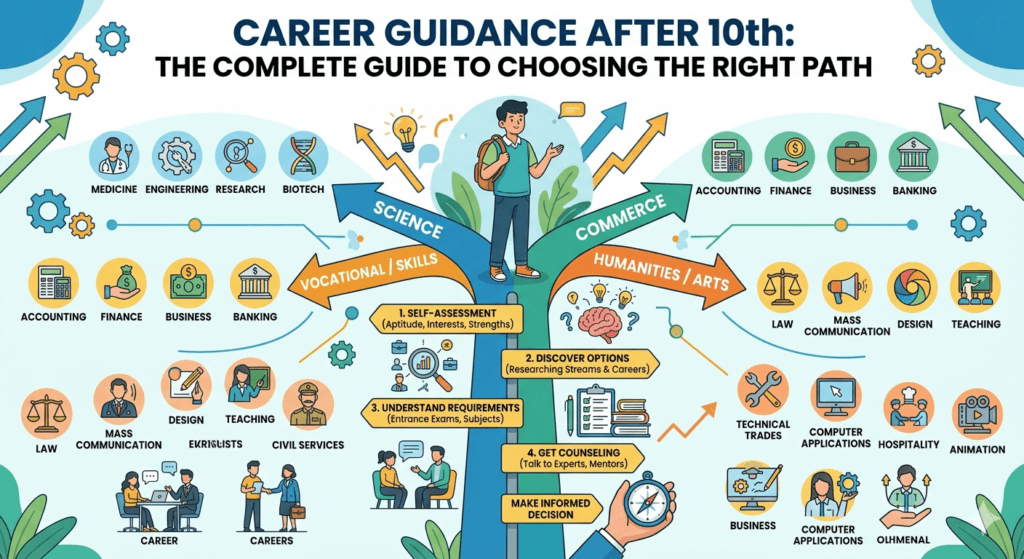
Why Career Planning After 10th Is Important
The transition after the 10th grade marks the beginning of specialized education. At this stage, students typically choose among Science, Commerce, or Arts/Humanities streams, each leading to different professional opportunities.
Effective career planning helps students:
Identify their strengths and talents
Align education with future career aspirations
Avoid confusion and unnecessary academic shifts later
Build a clear roadmap toward professional success
Making an informed decision at this stage ensures that students move forward with confidence, clarity, and purpose.
Major Streams After 10th
1. Science Stream
The Science stream is one of the most popular choices among students who are interested in technology, medicine, research, and engineering. It provides diverse career opportunities and keeps multiple career paths open.
Core Subjects
Students generally study:
Physics
Chemistry
Mathematics (PCM)
Biology (PCB)
Computer Science (optional)
Career Opportunities in Science
Students who choose science can pursue careers such as:
Engineering
Medicine
Pharmacy
Biotechnology
Architecture
Data Science
Artificial Intelligence
Research and Development
Popular Courses After 12th (Science)
B.Tech / BE
MBBS
BDS
B.Sc
B.Pharm
B.Arch
BCA
Science is ideal for students who enjoy problem solving, analytical thinking, and scientific exploration.
2. Commerce Stream
The Commerce stream focuses on business, finance, economics, and entrepreneurship. Students who have an interest in business management, accounting, banking, and corporate careers often choose this stream.
Core Subjects
Typical subjects include:
Accountancy
Business Studies
Economics
Mathematics (optional)
Statistics
Career Opportunities in Commerce
Commerce opens doors to many high-demand professional careers, including:
Chartered Accountant (CA)
Company Secretary (CS)
Investment Banker
Financial Analyst
Business Manager
Entrepreneur
Popular Courses After 12th (Commerce)
B.Com
BBA
CA
CS
CMA
Bachelor in Economics
Commerce is ideal for students who are interested in finance, management, and the corporate world.
3. Arts / Humanities Stream
The Arts or Humanities stream is perfect for students interested in social sciences, creativity, public administration, and communication fields. Contrary to common misconceptions, this stream offers many prestigious career opportunities.
Core Subjects
Students may study:
History
Geography
Political Science
Sociology
Psychology
Economics
Literature
Career Opportunities in Arts
Students pursuing humanities can enter fields such as:
Civil Services
Journalism
Law
Teaching
Psychology
Public Administration
International Relations
Popular Courses After 12th (Arts)
BA
LLB
BFA (Fine Arts)
BJMC (Journalism and Mass Communication)
Hotel Management
Fashion Designing
The Arts stream is excellent for students who enjoy creative expression, social studies, and communication.
Diploma Courses After 10th
Students who prefer practical training and early career entry can pursue diploma programs after the 10th grade. These programs typically last 2–3 years and provide specialized technical skills.
Popular Diploma Courses
Diploma in Mechanical Engineering
Diploma in Civil Engineering
Diploma in Electrical Engineering
Diploma in Computer Engineering
Diploma in Automobile Engineering
Diploma in Electronics Engineering
These courses are offered by polytechnic institutes and provide direct entry into technical industries.
Benefits of Diploma Programs
Faster entry into the workforce
Hands-on technical skills
Affordable education compared to degree programs
Opportunities to pursue lateral entry into engineering degrees
Diploma courses are suitable for students who prefer technical learning over theoretical academics.
Vocational Courses After 10th
Vocational education focuses on skill development and industry-specific training. These programs prepare students for employment in a shorter time frame.
Popular Vocational Courses
IT Technician Training
Graphic Designing
Digital Marketing
Fashion Designing
Animation and Multimedia
Photography
Hotel Management
Beauty and Wellness
Vocational courses help students develop job-ready skills and often include internships or practical workshops.
ITI Courses After 10th
The Industrial Training Institute (ITI) programs are designed for students who want to build careers in technical trades and skilled professions.
Popular ITI Trades
Electrician
Fitter
Welder
Plumber
Carpenter
Mechanic
Refrigeration Technician
ITI courses generally last 1–2 years and offer excellent employment opportunities in industrial sectors.
Many graduates find jobs in:
Manufacturing industries
Construction companies
Automobile workshops
Government technical departments
Emerging Career Fields Students Should Consider
Modern industries are evolving rapidly, creating new career opportunities beyond traditional professions.
High-Growth Career Fields
Artificial Intelligence
Cybersecurity
Data Science
Robotics
Cloud Computing
Game Development
Digital Marketing
Content Creation
Students who develop technical and digital skills early gain a significant advantage in these growing industries.
How to Choose the Right Career After 10th
Choosing the right path requires careful analysis. We recommend evaluating the following factors before making a decision.
1. Identify Personal Interests
Students should choose a field that genuinely interests them. Passion leads to better academic performance and long-term satisfaction.
2. Assess Strengths and Skills
Understanding one’s academic strengths, creativity, communication abilities, or technical aptitude can help determine the most suitable stream.
3. Explore Future Career Opportunities
Students should research the long-term scope, job stability, and growth potential of different careers.
4. Seek Career Counseling
Professional career counselors, teachers, and mentors can provide valuable insights and guidance.
5. Consider Industry Demand
Choosing fields with high demand and future growth potential increases the likelihood of career success.
Mistakes Students Should Avoid After 10th
Many students make career decisions based on peer pressure or societal expectations. Avoiding these mistakes is crucial.
Common Mistakes
Choosing a stream because friends selected it
Following family pressure instead of personal interest
Ignoring long-term career goals
Lack of research about available options
Underestimating vocational and skill-based careers
Successful career planning requires independent thinking and informed decision-making.
Role of Parents in Career Guidance
Parents play an essential role in helping students navigate career decisions. Instead of imposing choices, parents should:
Encourage open discussions
Understand their child’s interests
Support exploration of multiple career paths
Provide emotional and educational support
A supportive environment helps students make confident decisions about their future.
Conclusion
Selecting the right career path after the 10th standard is a critical milestone that shapes future academic and professional success. Students today have a wide range of options including Science, Commerce, Arts, diploma programs, vocational courses, and technical training.
The most successful decisions come from self-awareness, proper research, and thoughtful planning. By identifying personal interests, evaluating strengths, and exploring emerging industries, students can confidently choose a path that leads to long-term fulfillment and career growth.
With the right guidance, determination, and continuous learning, students can build a successful and rewarding future after the 10th grade.
Join Whatsapp Group for daily Job Notification Join In below Group
https://whatsapp.com/channel/0029Vb7ItFeKQuJLX55H8x1z
https://chat.whatsapp.com/LtAGZg1aswMHZoiZ8dUVvX
To Join Telegram Channel Click Below Link